

What Jazz, Bartending and Branding Have in Common: Mastery Through Rhythm, Timing and Experience
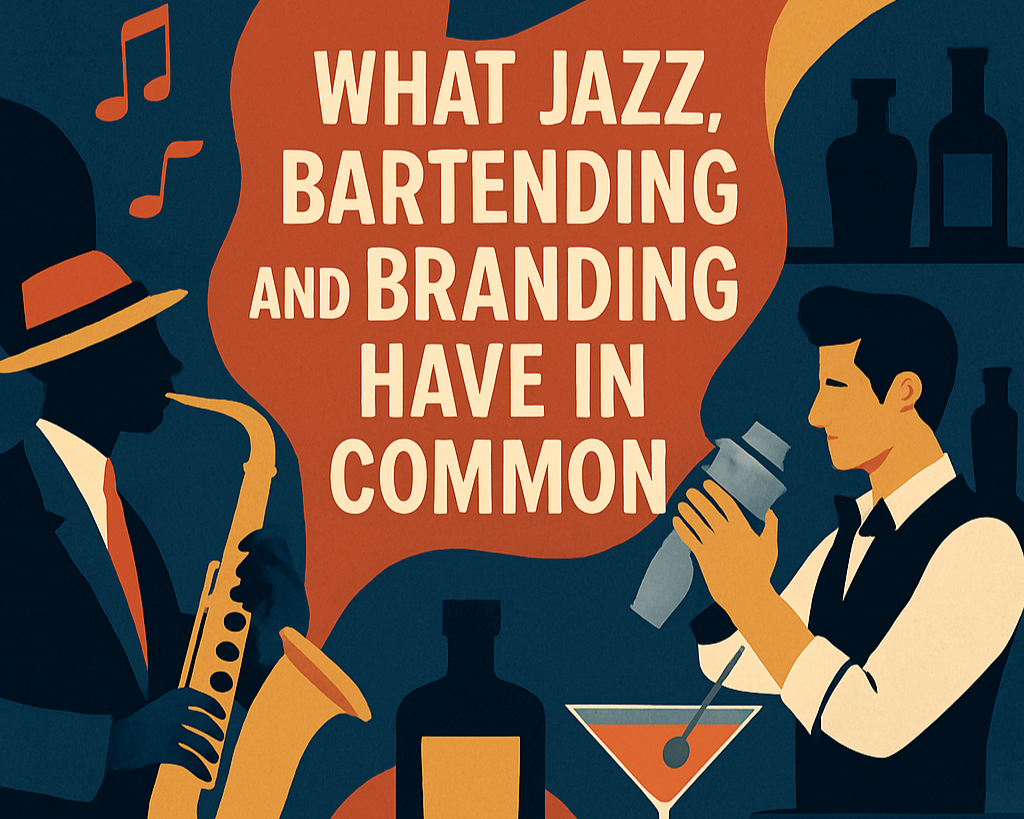
Brand mastery is craft: rhythm, timing and experience working in harmony.
Most brands try to grow by adding more tactics, more tools and more content. Very few ask a sharper question: does our brand move with rhythm, timing and intention, or are we just making noise?
To answer that, it helps to look outside marketing. Three worlds illustrate brand mastery with surprising clarity:
Jazz
Bartending
Strategic branding
On the surface they look unrelated. In reality, they share the same underlying discipline. They depend on rhythm, timing, experience and coherence. When brands adopt this logic, everything from their inbound marketing strategy to their web design, content, automation flows and sales and CRM starts to work together instead of competing for attention.
This is the operating system behind Link&Grow Global. It is also the difference between a brand that people notice once and a brand that quietly becomes the natural choice.
1. Rhythm: the steady pulse behind brand performance
Great jazz musicians do not improvise randomly. They move inside a structure. They know the time signature, the harmony and the space available. Then they explore.
High performing teams behave in a similar way. Research highlighted by Harvard Business Review shows that the best teams combine clear structure with autonomy and shared discipline, which increases reliability and creative output at the same time.
Branding needs the same kind of rhythm.
A brand without rhythm:
Posts inconsistently
Changes its visual language every few months
Redesigns the website without a clear goal
Launches campaigns that feel disconnected
A brand with rhythm:
Repeats core messages intentionally
Aligns design, copy and experience
Uses its website as a stable base for campaigns
Keeps publishing content that compounds over time
This rhythm is what you build when you take strategic branding seriously, as explored in Strategic Branding: The Invisible Engine Driving Global Business Growth and Brand and Marketing Design: Why It Matters for Every Business.
In practical terms, rhythm in your digital ecosystem is created through:
A clear brand platform and visual system
A consistent SEO and content plan
A website designed for conversion rather than decoration, as discussed in 10 Website Mistakes That Quietly Destroy Your Conversion Rate
Regular performance reviews that guide small course corrections, not constant reinvention
Without this pulse, even strong campaigns lose power. With it, every touchpoint reinforces the same identity and promise.
2. Timing: why the moment often decides the conversion
A skilled bartender does not only know recipes. They understand when to shake, when to stir, when to add dilution and when to stop. A few seconds too long and the drink loses structure. A few seconds too short and it feels unbalanced.
In digital strategy the same logic applies. Conversion is not only about the message. It is about the moment.
Nielsen research shows that balance across the customer journey is essential: ongoing, always on efforts can represent ten to thirty five percent of brand equity and the long term impact of media can even double the return on investment of marketing spend. The brands that win are the ones that understand when people are discovering, comparing, deciding and returning.
This is where the full stack of Link&Grow Global tools becomes relevant:
PPC campaigns capture intent at the exact search moment
Social media strategies build familiarity before the need arises
Email marketing nurtures leads between first contact and decision
Automation sends the right sequence at the right time instead of flooding inboxes
Sales and CRM track readiness and prevent premature or late follow up
In UX and UI Design: Crafting Digital Experiences That Convert the focus is very similar: create interfaces that respect where the user is in the journey and reduce friction exactly where it matters.
Good bartenders do not rush guests. Good brands should not rush prospects. Timing is an act of respect as much as it is a conversion lever.
3. Experience: the true engine of growth, not a soft extra
Ask people why they return to a specific bar or live jazz venue. They rarely answer with technical jargon. They talk about how it feels. The way the room sounds. The way the bartender remembers their usual order. The way the band builds tension and release.
In branding, we call this experience, and it is not cosmetic.
McKinsey analysis shows that companies that lead in customer experience achieve more than double the revenue growth of laggards and also benefit from significant cost reductions in the medium term. Customer experience is not a nice extra. It is a financial strategy.
For a brand, experience is created across multiple layers:
The clarity and usefulness of your content
The way your e commerce experience handles doubt and risk
The speed and simplicity of your forms and checkouts
The tone of your support interactions
The way your emails respect attention rather than abuse it
This is why an integrated approach, as outlined in Inbound Marketing for Global Growth, outperforms fragmented tactics. It treats the buyer journey as a connected path instead of isolated campaigns.
Jazz, bartending and branding all reward brands that design for experience, not only exposure.
4. Mastery and flexibility: structure that still allows improvisation
The best jazz players know theory so well that they can leave the sheet without losing the harmony. The best bartenders can adapt a classic recipe to a guest without breaking the drink.
The same applies to modern digital strategy. You need enough structure to avoid randomness and enough flexibility to adapt to context.
Research referenced by Deloitte shows that organizations which embrace agility and flexibility are more than twice as likely to outperform their peers financially. McKinsey’s work on modern organizations reinforces this: balancing flexibility with structure leads to higher productivity, innovation and resilience.
In practice, for a brand, this balance looks like:
A clear strategic foundation and brand system
A content calendar that can still respond to real events
Campaign frameworks that are tested and repeatable, but open to creative variation
Automation that adjusts to behaviour instead of forcing users through rigid flows
A CRM setup that gives sales teams guidance without suffocating their judgement
This is exactly how Link&Grow Global positions services such as lead generation, SEO and content strategy: structured enough to scale, flexible enough to stay human.
Mastery in branding is not perfection. It is the ability to adapt without losing yourself.
5. Coherence: the quiet force that makes a brand feel inevitable
In music, if each musician plays well but does not listen to the others, the result feels chaotic. In a bar, if the drink is excellent but the environment is careless, the experience falls apart.
The same happens in companies that treat branding, performance marketing, design and sales as separate worlds. Each team may be competent. The whole still feels fragmented.
Coherence is what holds everything together:
The same promise reflected in your website, ads and sales calls
The same tone in your blog, emails and social channels
The same logic guiding your data, reporting and decision making
The article How to Evaluate Your Brand in 5 Minutes is essentially a coherence test. It helps leaders see whether their brand behaves like a unified system or a collection of disconnected efforts.
At Link&Grow Global, this coherence is what ties together:
Strategy and execution
Creative and performance
Brand and technology
When coherence is present, your brand does not feel like an aggressive interruption. It feels like the natural, trustworthy option in a noisy market.
Conclusion: treat your brand like a craft, not a campaign
Jazz, bartending and branding reward the same posture:
Respect for rhythm
Sensitivity to timing
Obsession with experience
Discipline that allows freedom
Coherence that aligns everything you do
If your marketing ecosystem does not yet work this way, you are leaving growth on the table. You may have solid ingredients, but not yet the craft that turns them into something people remember and actively choose.
You do not fix this with another isolated campaign. You fix it by redesigning the way your brand works as a whole: strategy, inbound marketing, web experience, SEO and content, automation, PPC and sales operations aligned under the same score.
If you want to understand where your brand is strong, where it is out of sync and what to change first, the next step is simple.
